



/ Blog

October 22, 2026
The Wicked Witch’s Hut: Fit to Frighten
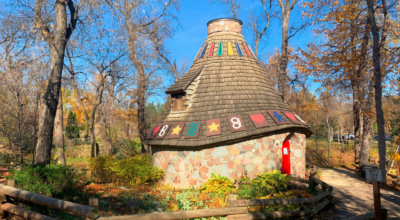
A charming round house sits nestled in the woods along a quaint creek. Its whimsical design, humble scale, and bright orange door draw children in, eager to discover what fun it might hold. It looks like a fairy tale brought to life, straight from your imagination. But the building’s playful exterior hides something darker, more sinister… What frightening story lies within? Would you dare to venture inside?
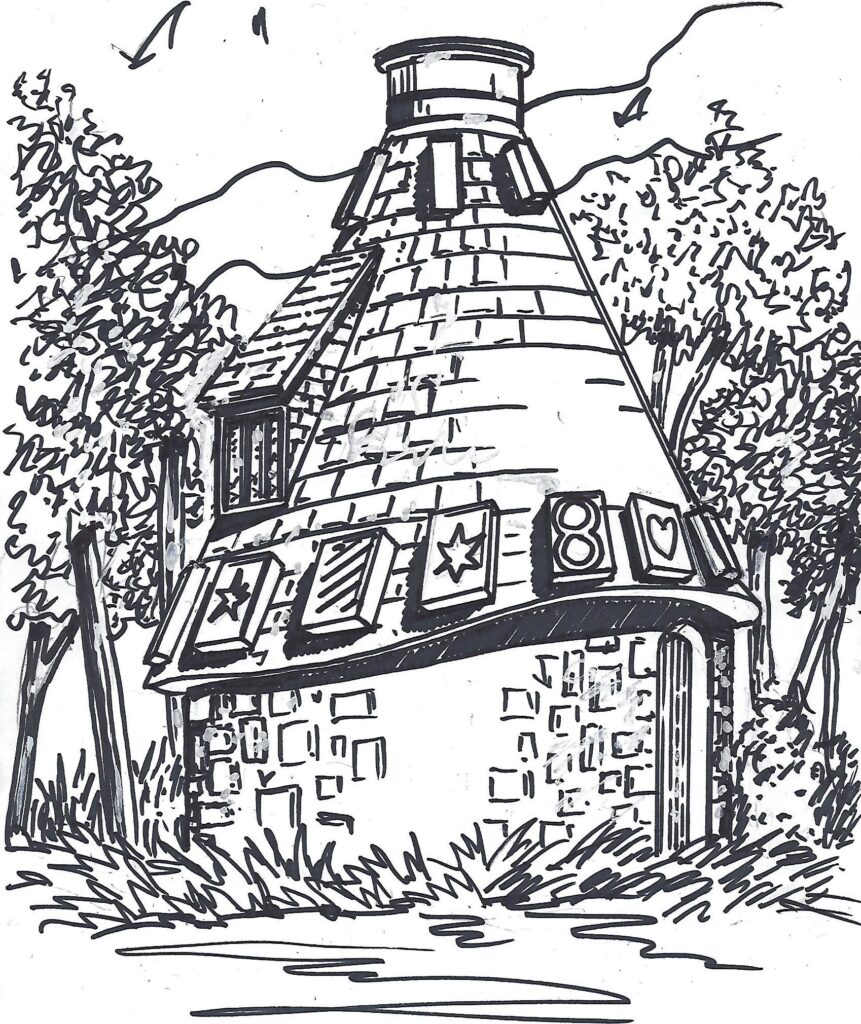
A drawing of Witch’s Hut in Kildonan Park in 2021.
Source: Robert Sweeney (via Heritage Winnipeg)
The Fairy Tale Cottage, or Märchenhaus in German, officially opened in Kildonan Park on October 24th, 1970. Now known as the Witch’s Hut, the building was a project of the German Community of Manitoba. Presented as a gift to the children of Manitoba, it was also a Centennial Project, part of the province’s 100th anniversary celebration. Located on the southern bank of Lord Selkirk Creek, just off Peguis Drive, the hut cost $18,000 to build, with most of the funds coming from donations.
The design of the Witch’s Hut was based on the German fairy tale “Hansel and Gretel”. The story was first published in the 1812 Kinder- und Hausmärchen (Children’s and Household Tales) by German brothers Jacob and Wilhelm Grimm. The book contained 86 folk tales collected and edited by the brothers, bringing together stories that had been passed through generations and across cultures. The book had immediate and lasting success, with seven ever growing editions eventually being printed; it included well-known stories such as “Snow White” and “Cinderella”. Read throughout the world, the Grimms’ work became the foundation for the study of folk tales.
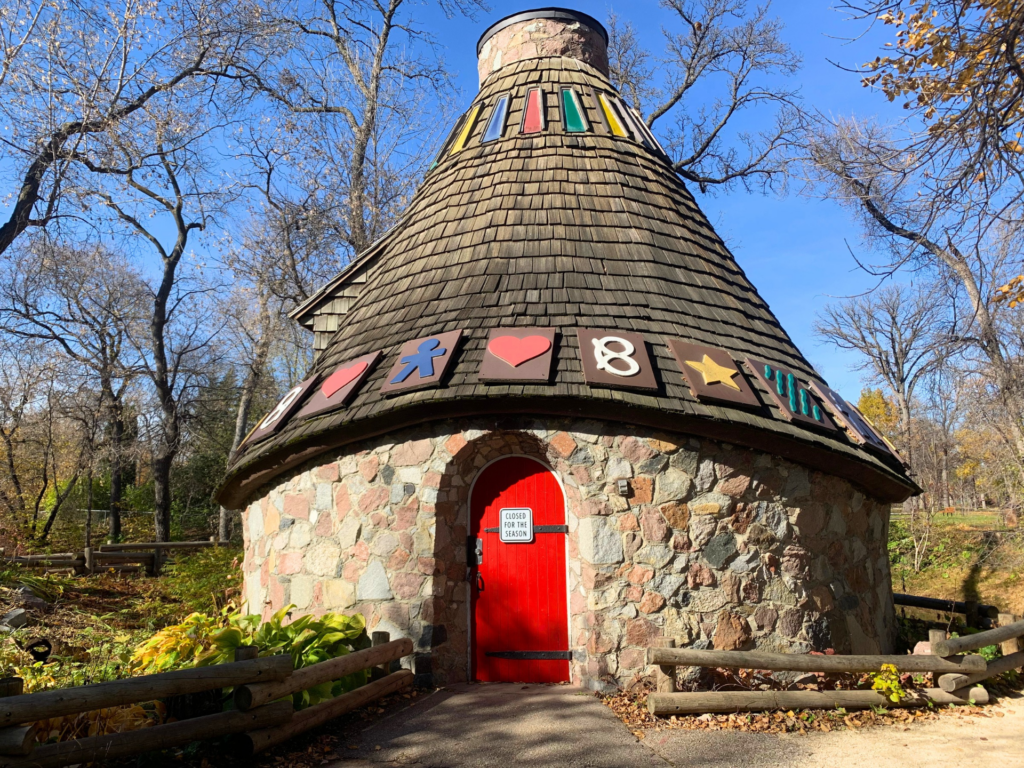
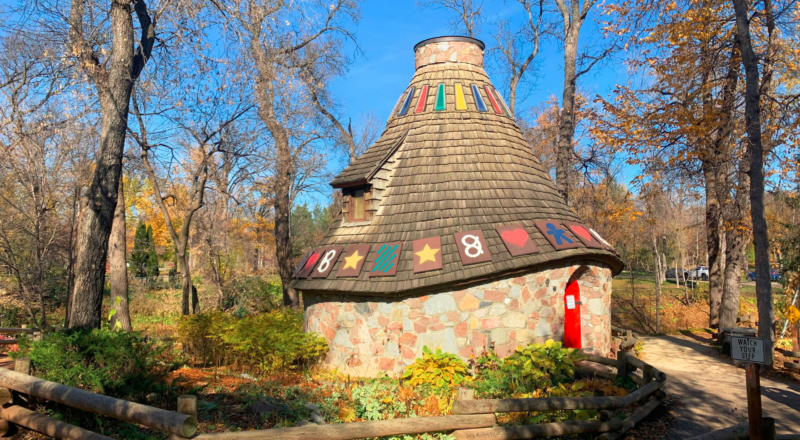
The Witch’s Hut in Kildonan Park in October 2026.
Source: Heritage Winnipeg
Today we often think of fairy tales as cute stories for children, but some of the Grimms’ stories were far darker. “Hansel and Gretel” was one of these, more likely intended for an adult audience. While people can often recall it as the story of children lost in the woods, finding the witch’s gingerbread house, and escaping the witch before returning home, they are unfamiliar with the disturbing original details. It is a story of starvation, child abandonment, imprisonment, slavery, attempted cannibalism, and a gruesome death. It is truly the stuff of horror stories, not for the faint of heart.
“Hansel and Gretel” by the Grimm’s brothers tell the tale of a poor woodcutter who could not provide for his family during a famine. So that they should not all starve, the woodcutter’s wife convinces him to abandon their two children in the woods, knowing it is full of dangerous animals. The children, Hansel and Gretel, are aware of this plan and foil it on the first attempt, but are successfully abandoned the second time. Wandering in the woods, the starving children find the witch’s edible house and begin to eat it. The witch takes the children in, locking Hansel in a stall while forcing Gretel to work. The witch plans to eat the children, but quick-thinking Gretel is able to push her into the oven instead, killing her. After freeing Hansel, the children fill their pockets with the witch’s treasures and find their way home. There they learn that their mother has died, but their father is delighted to see them, living happily ever after. It is unclear if the woodcutter’s wife was the children’s mom, referred to both as “mother” and “stepmother” in the story. As her demise coincided with the death of the witch, some have also suggested the two women are metaphorically the same character.
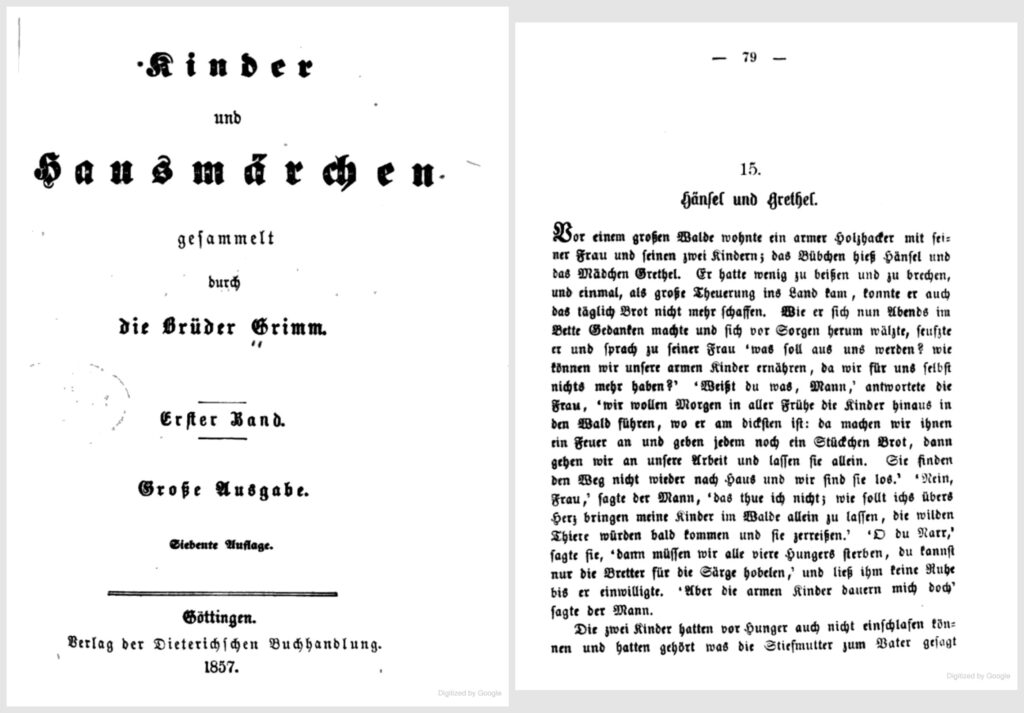
The book’s cover page and first page of “Hansel and Gretel” from the 1857 edition of Kinder und hausmärchen: gesammelt durch die Brüder Grimm (Children’s and Household Tales: Collected by the Brothers Grimm).
Source: Digitized by Google (public domain)
In the Grimm’s version of “Hansel and Gretel,” the witch’s house was described as being “built entirely from bread with a roof made of cake, and the windows were made of clear sugar,” (translated by D. L. Ashliman). But that is not the house most people associate with the story today. We imagine a gingerbread fantasy, dripping with icing and decorated with fanciful candies. When did the renovation in our collective memory take place? Both the folk tale and the tradition of making gingerbread houses predate the publication of “Hansel and Gretel” by hundreds of years, making it unclear if the treats inspired the story or the story was inspired by the treats. What we can be sure of is that by the time the opera version of “Hansel and Gretel” premiered in 1893, the witch’s house had been upgraded to gingerbread.
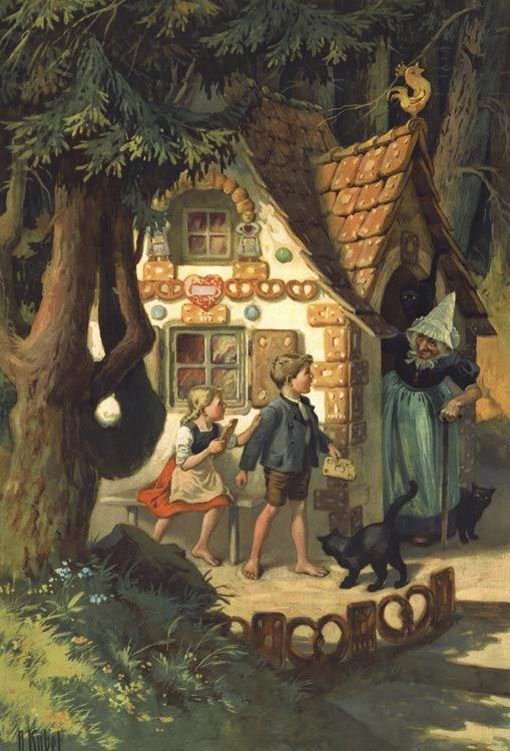
An artist’s depiction of Hansel and Gretel nibbling on the witch’s cheerful gingerbread house from 1930.
Source: Otto Kubel, 1868 – 1951 (public domain, via Wikimedia Commons)
The Witch’s Hut in Kildonan Park was designed by local architect Hans Peter Langes. Born in Germany, Langes moved to Canada in 1951 after finishing his studies in architecture, settling down in Winnipeg. He would go on to work on a variety of projects throughout the province, including taking part in the design of Polo Park Shopping Centre. In 1988, Langes won a Heritage Conservation Award at Heritage Winnipeg’s Annual Preservation Awards for his work on the Manitoba Law Courts at 391 Broadway Avenue.
A tribute to his German heritage, Langes happily agreed to work on the Witch’s Hut project. He soon presented the planning committee with a surprising proposal of medieval inspiration. Instead of the square gingerbread house covered in colourful sweets, he had designed a muted round fieldstone building with a conical roof made to look like brown gingerbread decorated with white icing. His own daughter, Jane Langes, was not impressed, wanting a more traditional gingerbread house. But the unexpected design was used, with a few changes to the roof. Covered in cedar shakes, the decorated gingerbread was limited to a single row of cookies along the bottom edge, with coloured panes of glass were set up around the chimney that came through the centre.
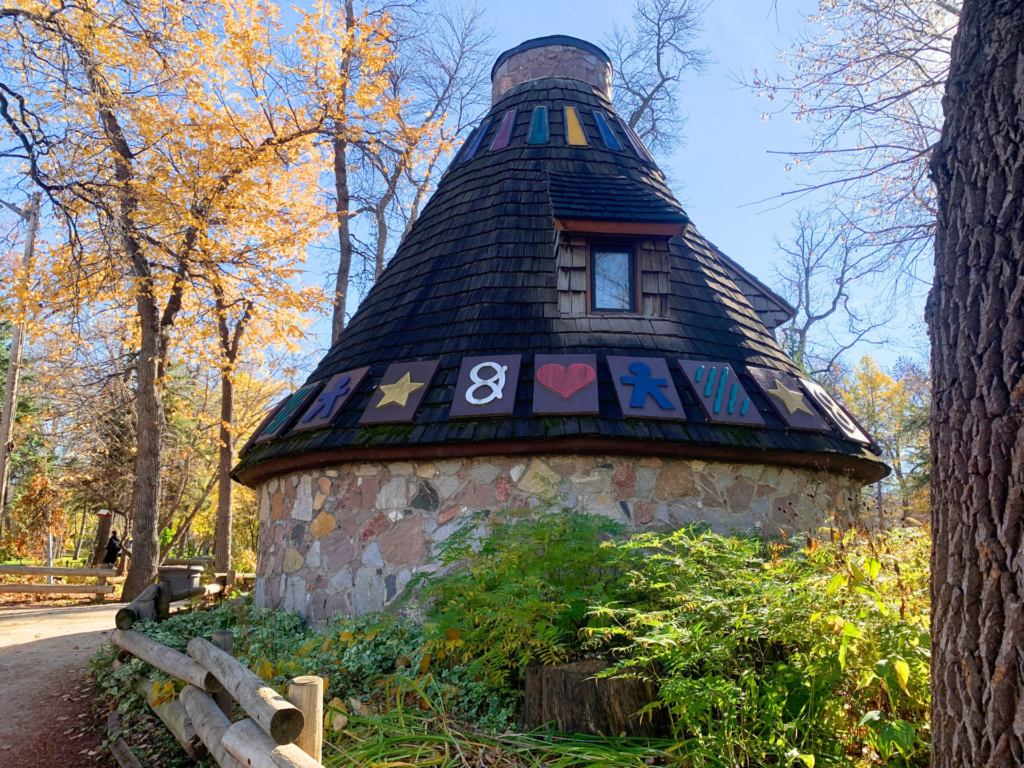
The Witch’s Hut in Kildonan Park in October 2026.
Source: Heritage Winnipeg
While the exterior of the Witch’s Hut might have initially disappointed some, the building was nothing short of a work of art, and a labour of love. A curved door led to the interior, with the large stone chimney anchoring the middle of the building. In front of the chimney sat a curved wooden desk. To the left was a series of relief terracotta panels depicting the story of “Hansel and Gretel” in bright colours, made by Elfriede Berger. To the right of the entrance was a stone and wood staircase gracefully following the curve of the wall, leading up to the mezzanine level. Under the stairs, behind wooden bars was a small room with Hansel trapped inside, a foreshadowing of the fright that was to come. This stonemasonry and woodwork, along with that of the rest of the building, was done by John Nelson.
Sun shining through the colourful glass panes around the chimney invited guests to climb the stairs and discover the final secrets of the Witch’s Hut. Children are rightfully hesitant to ascend… Up on the mezzanine was a terrifying sight – the wicked witch flying on her broomstick, suspended from the ceiling by cables, with a black cat riding on her back! Below, poor Gretel was forced to do chores by the woodstove. The life-sized figurines were handcrafted by Josef Potempa, who perfectly captured the spirit of the witch: menacing, cunning and evil. She was the stuff of nightmares, haunting the dreams of children across the city for generations.
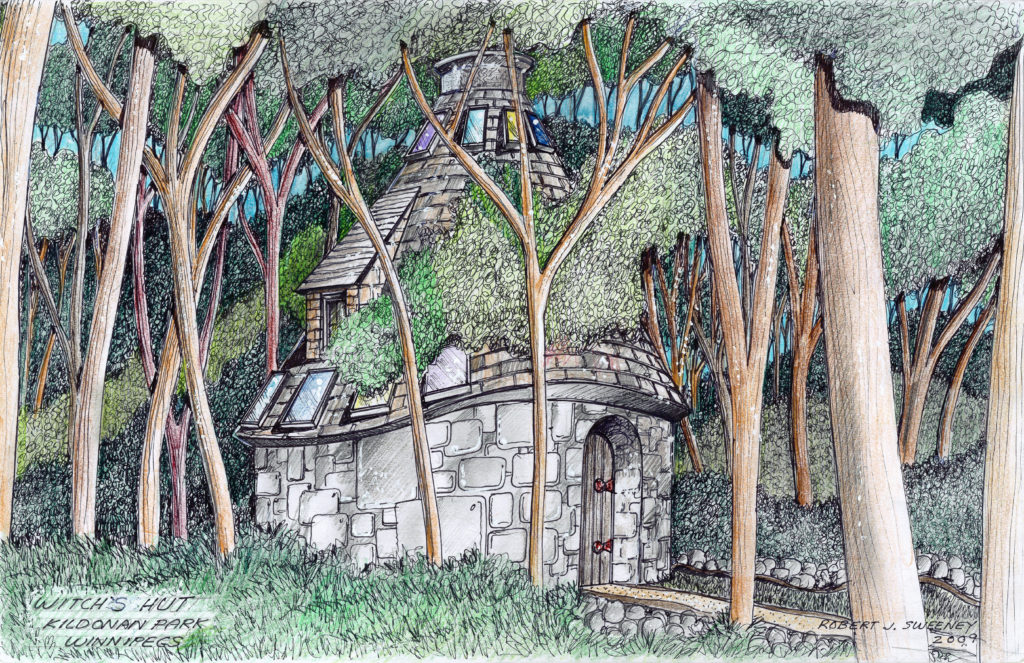
An illustration of the Witch’s Hut in Kildonan Park from 2009.
Source: Robert Sweeney (via Heritage Winnipeg)
Over the years, there have been a few changes at the Witch’s Hut. The roof was replaced in 2014, and new gingerbread cookies with colourful decorations now adorn the edge, more resistant to Winnipeg’s harsh weather. Once brown, the door is now painted a bright shade of orange, standing out in its forest setting. Inside, the wicked witch and her warty nose have come down from their broomstick, replaced with a new version tending to a bubbling cauldron on the woodstove. No less terrifying than the original witch, her toothy grin fails to conceal her murderous intentions. And if the creepy figurines are not frightening enough, visitors can look up to find a giant spider dangling from the ceiling, ready to drop on an unsuspecting victim.
For those brave souls with the courage to visit the Witch’s Hut, it is open in the summer months. Once operated by park staff, in past years it has been volunteers opening the door. Jim Zacharkiw, a dedicated volunteer who has returned summer after summer with a wealth of knowledge and enthusiasm, also took the time to refresh the colour glass panes and add new gingerbread ornaments inside. An iconic landmark in Kildonan Park, the building sees tens of thousands of visitors each summer, with families often making it a tradition to return year after year. In addition to exploring inside the hut, some summers the German-Canadian Congress also presents story time sessions outside, sharing versions of the Grimm brothers’ fairy tales for children.
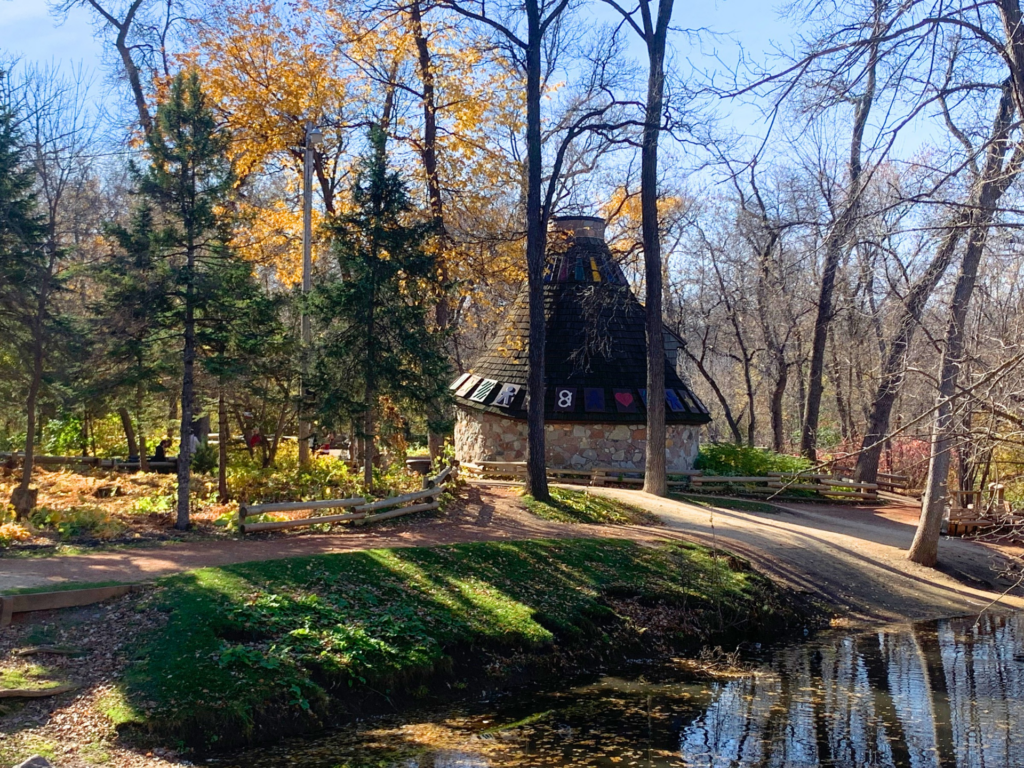
The Witch’s Hut in Kildonan Park in October 2026 with Lord Selkirk Creek in the foreground.
Source: Heritage Winnipeg
As summer ends, the lights are turned off, the door is locked, and the Witch’s Hut is closed for the season. The darkened building sits quietly in the woods, its appearance only made more eerie by barren trees surrounding it. Yet many Winnipeggers hold warm memories of the little hut, remembering when they first found the courage to climb the stairs and visit the witch’s lair. It might not be quite what the Grimm brothers had in mind, but it can send shivers up your spine just like the original fairy tale. And despite its scary history and inhabitants, the Witch’s Hut has an important lesson to teach visitors: during the spooky season, be sure to keep an eye on the sky for wicked witches flying on broomsticks and do not go nibbling on strangers’ houses!
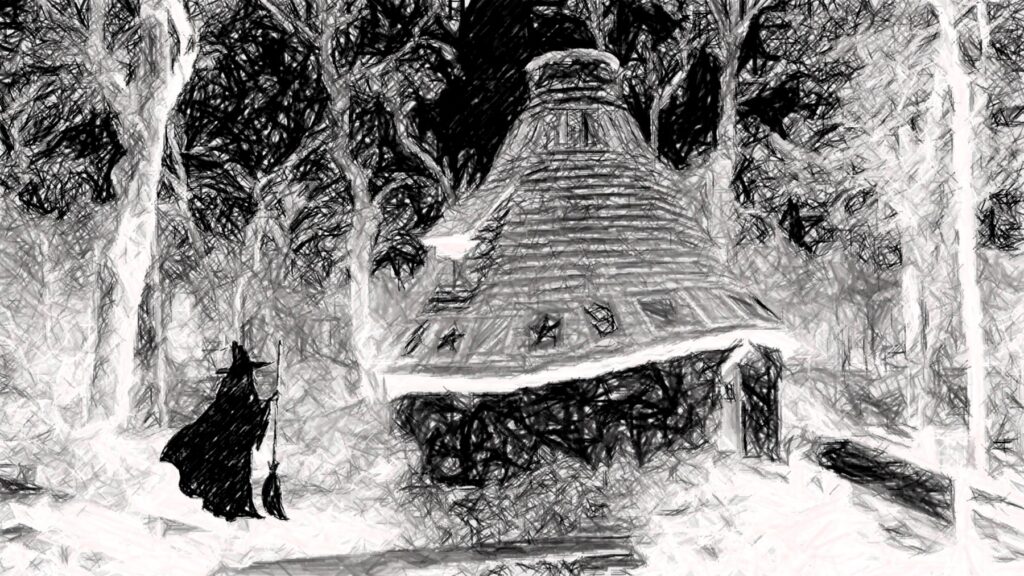
The Witch’s Hut in Kildonan Park in October 2026, edited.
Source: Heritage Winnipeg
THANK YOU TO THE SPONSOR OF THIS BLOG POST:

Written by Heritage Winnipeg.
SOURCES:
2026 Witch’s Hut Fairy Tale Reading | German Missions in Canada - June 30, 2026
Brothers Grimm | Ludwig Denecke - September 14, 2026 - Encyclopaedia Britannica
Gingerbread house | Janine Ungvarsky - 2021 - EBSCOhost
Grimm Brothers' Home Page | D. L. Ashliman - October 1, 2013 - University of Pittsburg
Hänsel and Gretel | Linda Cantoni and Betsy Schwarm - December 23, 2024 - Encyclopedia Britannica
Hansel and Gretel Fairytale Cottage (Witch's Hut), Kildonan Park | Winnipeg Architecture Foundation
HANS PETER LANGES | The Free Press Passages
Hans Peter Langes | Winnipeg Architecture Foundation
Once Upon A Time: On the Nature of Fairy Tales | Max Lüthi - 1970 - Frederick Ungar Publishing Co.
Toil and trouble brewing at witch’s hut | Nick Martin - July 22, 2015 - The Free Press
Witch's Hut | City of Winnipeg - August 6, 2026
The Witch's Hut | German Canadian Congress Manitoba
What is the Witch’s Hut in Kildonan Park? | July 21, 2015 - The Free Press
Witch’s Hut offers scary good time | Gabriela Klimes - May 30, 2012 - Free Press Community Review