










/ News

February 27, 2025
The Craig Block & Winnipeg’s Black History
February is Black History Month, a time to reflect on and learn about the experiences, contributions, and culture of Black communities across Canada.
This year, February was preceded by the near loss of a building that holds great significance in Winnipeg’s Black history. The Craig Block at 795 Main Street was damaged when its neighbour, the Sutherland Hotel, caught fire on January 15th, 2025. This event is a reminder of the importance of sustaining not only our heritage buildings but the stories they tell as well.
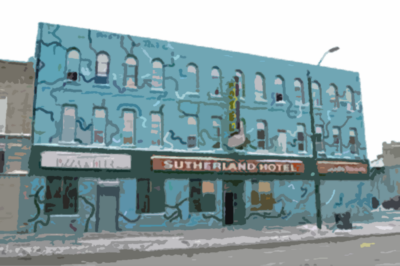
A digital painting of the Sutherland Hotel at 785 Main Street. The hotel burnt down on January 15th, 2025.
In the late 1800s, the Black community in Winnipeg’s North End was growing along with the city. Many had come north in hopes of escaping the Jim Crow laws of the American Midwest or had immigrated through Toronto from the West Indies. The systemic xenophobia and racism in Winnipeg had cornered many immigrants to the North End, where the quality of life was affected by a lack of resources and the noisy pollution of the Canadian National Railyards.
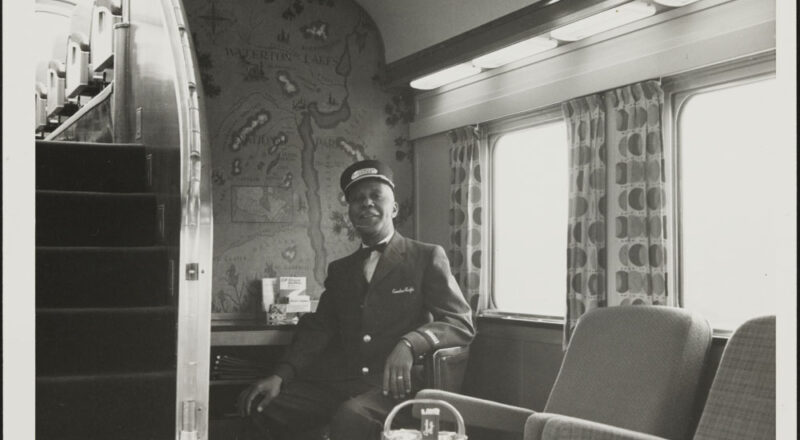
This discrimination also meant that job opportunities for Black Winnipeggers were sparse. While many would find work for the CN Rail, this was limited to positions as sleeping car porters. The porters took pride in their work, but their conditions were harsh. Black railway employees were paid substantially less than their white counterparts. They were expected to wait on the needs of every passenger. Until the 1940s, they were given nowhere to sleep on train journeys that often lasted more than three consecutive days.
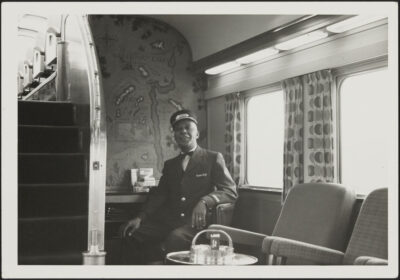
Albert Budd, C.P.R., S.C. Porter 1940s-1960s. Source: Government of Canada Library and Archives.
In addition to these conditions, sleeping car porters faced discrimination not only from management and clientele but also from their white coworkers. In 1917, a group of porters led by John A. Robinson requested to join the Canadian Brotherhood of Railway Employees (CBRE) They were denied access as the Brotherhood was only intended for white railway employees. It was then that John A. Robinson and his peers created the Order of Sleeping Car Porter (OSCP), the first black railway union (and possibly the first black union) in North America. Despite the lack of support from the CBRE, the OSCP were not hesitant to lend a hand during the 1919 Winnipeg General Strike. They contributed financially to the strike and walked out alongside their white co-workers, risking their lives and livelihoods for the very people that had turned them away.
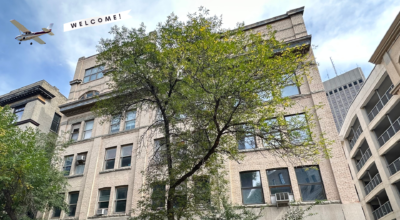
In 1922, the OSCP moved into the second floor of the Craig Block at 795 Main Street, a modest two-storey 1894 brick building. From then on, the building became an important part of Winnipeg’s Black history. In the late 20s, the main floor was home to various businesses owned and operated by members of the Black community. In the 30s, the Porters’ Social and Charitable Association took over the management of the upstairs hall, which was put to good use for the community. At one point, the building was used by Regent Lodge #5, the Black division of the Masons. There is proof of the building being used by the Black community until at least 1987.
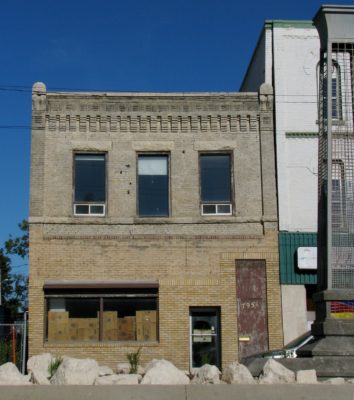
The Craig Block at 795 Main Street circa 2012
Source: Christian Cassidy
The legacy of the OSCP lived on as well. In the 30s and 40s, a porter named Lee Williams continued to push CN Rail for better wages and working conditions and to open other career opportunities for black people in the railway industry. His efforts led to the end of discriminatory practices that limited black employees to porter positions.
The loss of the neighbouring Sutherland hotel has raised the profile of the Craig Block as well as public awareness of the lack of education on Winnipeg’s Black history. While it is clear that the Craig Block is historically significant, it has never been considered for heritage designation or placed on any commemorative list. Because of this, most Winnipeggers are unaware of the Craig Block’s history and the OSCP entirely.
Thankfully, strides are being made to change that. Heritage Winnipeg has been in conversation with Black History Manitoba, working towards finding a building that will be the home of Winnipeg’s first Black History Museum.
Judy Williams, a representative of the Black History Museum initiative, has provided more information on the project:
“The vision of a Black History Museum in Manitoba has long been a dream shared by many Black community members and Black-led organizations. Establishing a dedicated space to archive, safeguard, and share historical documents, family heirlooms, photographs, journals, and other artifacts is essential in preserving and showcasing our presence and contributions to Manitoba’s history. Recognizing the urgency of this work, we see a pressing need to collect oral histories from aging community members, filling significant gaps in our provincial narrative. Additionally, it is crucial to identify and preserve historically significant spaces, buildings, and community hubs once owned or frequented by the Black community for business, social gatherings, and worship, securing heritage recognition or status where possible.
With this dream in mind, a foundational meeting was held on February 1, 2025, bringing together 25 engaged community members. The discussion focused on laying the groundwork for the Black History Museum (placeholder name) in Winnipeg. Participants shared personal connections, professional expertise, and ideas to shape the museum’s vision, emphasizing community involvement, cultural preservation, and historical education. The importance of collective efforts in preserving Black Canadian history in Manitoba was a central theme, with a strong commitment to creating a space that educates, celebrates, and empowers the community while addressing systemic barriers to historical recognition.
Potential locations for the museum were discussed, including:
The Craig Block – Recognized for its historical significance tied to Black labour movements, youth initiatives, and social groups such as the ACE Club.
Haynes Chicken Shack – A beloved establishment frequented by many community members, owned by Percy and Zena Haynes.
Point Douglas and Selkirk Avenue – Areas rich in Black cultural history.
Market Lands Redevelopment – A potential home for the museum alongside other arts and cultural organizations.
During the past two years, we conducted a pilot project and engaged with key institutions, including the Manitoba Museum, the University of Winnipeg’s Archives and Oral History Departments, and the Canadian Museum for Human Rights. These organizations have expressed strong support for our initiative, and we look forward to continued collaboration.
Both Black History Manitoba and ACOMI (African Communities of Manitoba Inc.) are key partners in this initiative. In just one month, our membership has grown significantly, with individuals stepping forward to contribute in areas such as grant writing, collections, gathering oral history, public speaking, history and exhibit, technology and community outreach. We look forward to hosting pop-up exhibitions in the coming months.
If you are interested in learning more about the Black History Museum initiative or getting involved, please reach out to Judy Williams at thebcemuseum@gmail.com.”
Sources:
“Building with deep links to Winnipeg’s Black history at risk after Sutherland Hotel blaze” Darren Bernhardt, CBC News, 19 January 2025.
“Craig Block link to city’s Black history” Winnipeg Free Press, CBC News, 26 August 2021.
“A century ago, Winnipeg railways became ‘birthplace’ of fight for black Canadian workers’ rights” Bryce Hoye, CBC News, 29 February 2020.