










/ Blog

July 22, 2026
Provincial Investment Brings New Life to Pantages Playhouse Theatre
The Pantages Playhouse Theatre, located at 180 Market Avenue, has stood as one of Winnipeg’s most recognizable venues in the Historic Exchange District for 110 years. Now, thanks to a $15 million investment from the provincial government, there is newfound hope for the historic theatre after years of threats of closure.
Designed by architect B. Marcus Priteca, the Pantages Playhouse Theatre was built between 1913 and 1914 for Alexander Pantages’ growing vaudeville circuit. Constructed at a cost of nearly $250,000, it was a substantial investment for the period. The theatre was designed in the Classical Revival style (sometimes referred to as “Pantages Greek”) with an elegant terra cotta façade, richly ornamented interior, and lavish plaster detailing that created a sense of grandeur for audiences before the curtain even rose. Priteca was the principal architect for Alexander Pantages’ theatre empire and designed dozens of theatres across North America. The Winnipeg theatre is considered one of his finest surviving works.
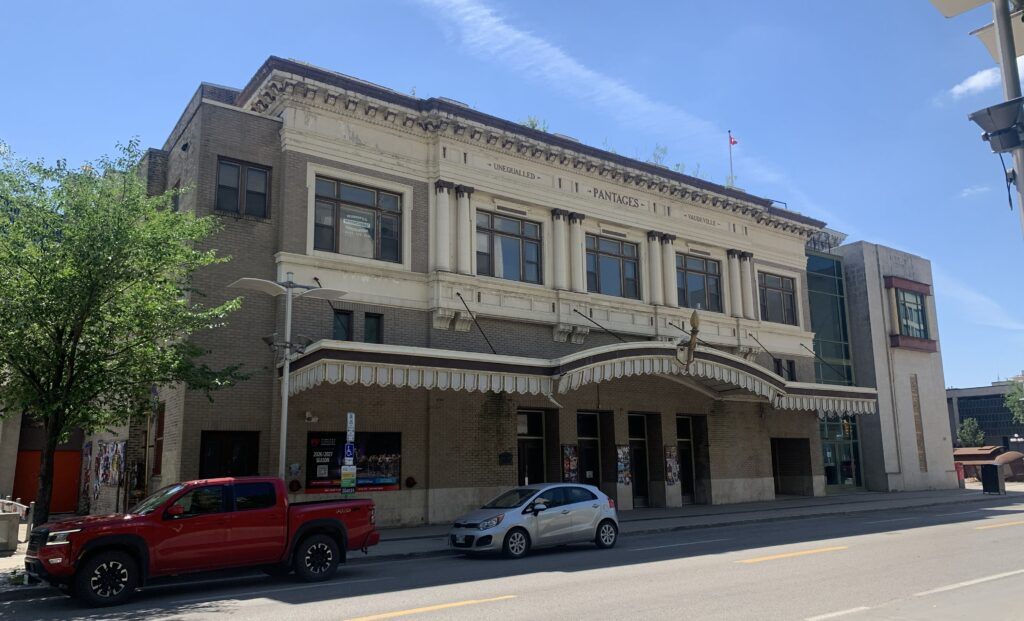
The Pantages Playhouse Theatre in July 2026. Source: Heritage Winnipeg
The Pantages Playhouse was also the first theatre of its size in North America to be constructed with a reinforced concrete frame, innovative engineering that helped ensure the building’s remarkable survival over more than a century. Originally recorded with a seating capacity of over 1,700, it was reduced to 1,500 in 1980.
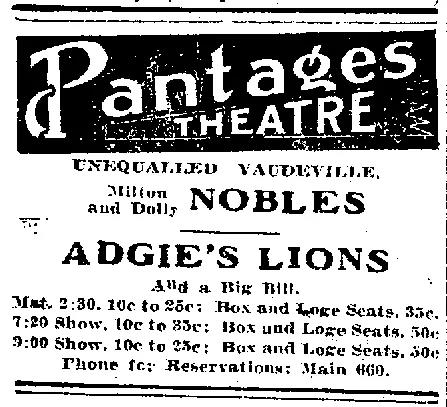
Ad for the Pantages Theatre’s opening night. Source: Winnipeg Free Press, p. 8, Feb 09, 1914.
Unlike many vaudeville theatres that were heavily altered or demolished, the Pantages retains much of its original architectural character. The Playhouse is one of only six surviving Pantages theatres in the world and Winnipeg’s only remaining vaudeville theatre. The theatre was created as a temple to vaudeville, a style of entertainment that dominated North American stages in the early twentieth century. Vaudeville was marketed as ‘variety’ entertainment and demanded that performers be versatile. Successful acts combined comedy, singing, juggling, magic, acrobatics, ventriloquism, and other skills into a single performance.
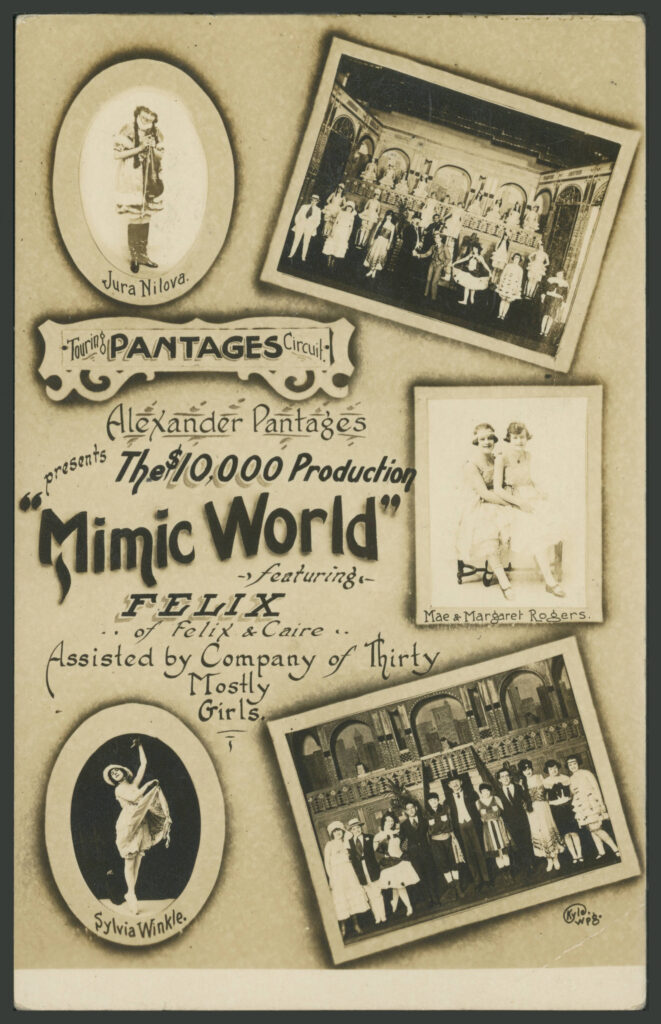
A collage-style promotional postcard for the ‘Mimic World’ production presented by Alexander Pantages’ circuit. Produced in Winnipeg ca. 1917. Source: Martin Berman Postcard Collection (public domain)
Historians divide the theatre’s early history into three distinct periods: the Pantages Years (1914–1923), the Playhouse Years (1923–1933), and the City Years (1936-Present). During its first decade, the theatre served as part of Alexander Pantages’ vaudeville circuit, where the success of an act in Winnipeg often determined whether it would continue westward to other theatres in the chain. Notable acts during the first decade include Buster Keaton and Stan Laurel from the Laurel and Hardy comedy duo.
However, the growing popularity of film began to take over live performances. By the early 1920s, films were becoming more affordable and increasingly sophisticated. On any given night, the Pantages Theatre was competing against ten movie theatres offering Winnipeggers new and exciting entertainment, and the Pantages’ vaudeville model became difficult to sustain. On June 23, 1923, it was announced that the Pantages: Unequalled Vaudeville Theatre would close.
Just three months later, the building reopened as the “Pantages Playhouse Theatre.” Under its new name, the venue hosted concerts, recitals, lectures, school productions, films, and even local boxing matches between scheduled performances. Eventually, many performing arts organizations migrated to the newly opened Winnipeg Auditorium in 1932, and the Playhouse quietly closed in June the following year. When attempts to sell the theatre to a new owner failed, the city acquired the building in 1936. In the years that followed, the theatre would continuously change its leases and tenants.
The theatre also holds a special place in the history of the Royal Winnipeg Ballet, the theatre’s longest-serving tenant. In June 1940, the company presented its first performance at the Pantages and continued to use the theatre as its home until the opening of the Centennial Concert Hall in 1968.
Over the decades, countless world renowned performers graced its stage. During the 1950s, one of the theatre’s most successful eras, major touring productions brought internationally celebrated artists to Winnipeg audiences. Shows such as The Greatest Jazz Concert in the World featured performers including Ella Fitzgerald, Buddy Rich, and Oscar Peterson.
On January 5th, 1981, the theatre was municipally designated a historical site by the City of Winnipeg. It was recognized as a National Historic Site of Canada in 1985, with a commemorative plaque installed in its lobby. Parks Canada’s current heritage records list November 15, 1986, as the official designation date and reference a 1989 statement of significance prepared by the Historic Sites and Monuments Board of Canada.
The Pantages has remained an integral part of Winnipeg’s arts community. For decades, organizations such as Dance Manitoba, the Winnipeg Fringe Festival, and the Winnipeg Comedy Festival have relied on the theatre as a performance site. Dance Manitoba has hosted its Showcase and annual spring festival at Pantages for almost four decades. The Winnipeg Fringe Festival used the Pantages as not one but two venues; they have had to find replacement venues for at least 10 performance groups since the theatre’s closure in 2018 forced many artists and arts organizations to look elsewhere.
The loss was particularly felt by performers who had developed a deep connection to the theatre. Local improviser and producer Caity Curtis, who performed at the Pantages during multiple Winnipeg Fringe Festivals, described it as her favourite theatre. She says that she and her partner, Stephen Sim, have decided not to perform their vaudeville show in this year’s festival because “if it’s not at the Pantages, it isn’t right.” She goes on to add,
Performing vaudeville at the Pantages Theatre has been the highlight of my career. I’ve never seen an audience fall in love with a show as quickly and deeply as I’ve seen happen at Pantages. While I’d love to take credit as a performer, I have to say there’s a power in the space that captivates everyone.
Their duo show, which is inspired by comedy greats like Burns and Allen, was met with great acclaim each year. For many artists, the Pantages offers something unique, a sense of intimacy, history, and atmosphere that could not be replicated elsewhere.
While much attention is focused on the 1914 theatre, the complex also includes a significant 1992 addition constructed for the Royal Winnipeg Ballet. Designed in a Postmodern architectural style, the addition reflects a very different era of design from the original theatre. Postmodern architecture emerged as a reaction against modernism, reintroducing historical references and decorative elements into contemporary buildings.
The addition will turn 40 in 2032, an age when many heritage professionals begin recognizing buildings for heritage designation.
Heritage Winnipeg commends the provincial government’s recent commitment of $15 million toward the theatre’s revitalization. The funding announcement, made in May of 2026, provided the final major piece of support needed to move the project forward. The project represents a partnership between the Performing Arts Consortium of Winnipeg, which purchased the building in 2020, and the Winnipeg Symphony Orchestra, which will serve as the managing tenant and help transform the space into a renewed performing arts centre.
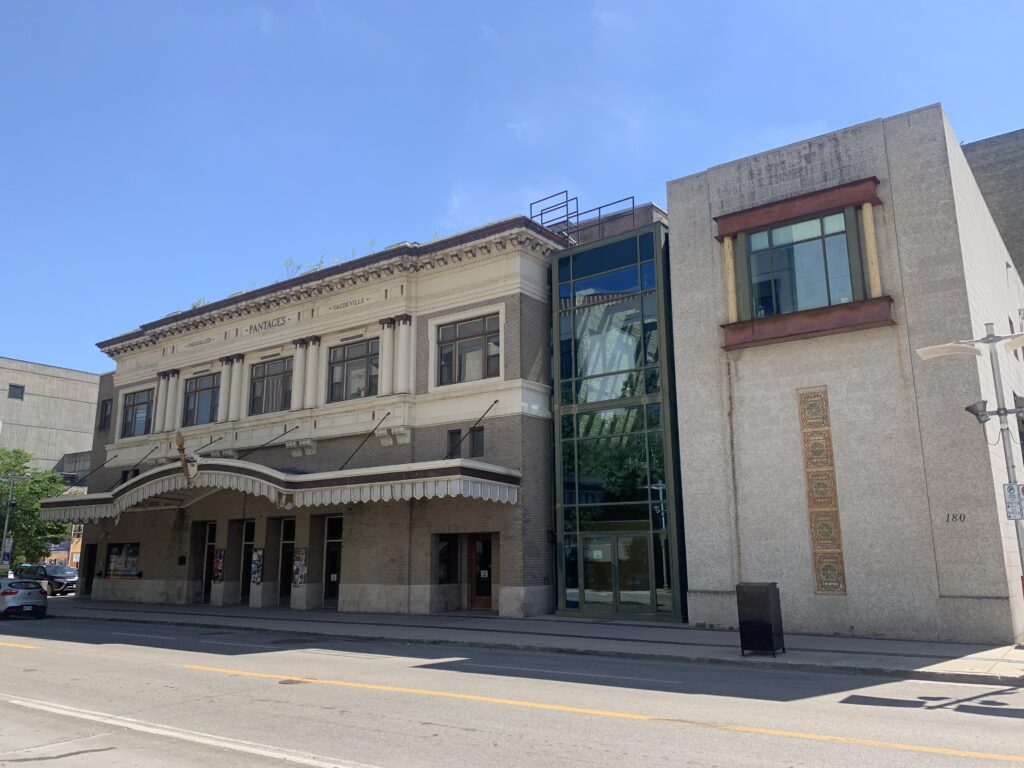
The Pantages Playhouse Theatre and the 1992 addition in July 2026. Source: Heritage Winnipeg
The renovated building will become the Winnipeg Symphony Orchestra’s permanent rehearsal, educational, administrative and mid-sized performance home while remaining available to community cultural organizations and other professional performing arts groups. Project leaders envision the theatre being active approximately 250 to 300 days each year, helping restore a major cultural destination to downtown Winnipeg. Bringing regular activity back into the building will help secure the theatre’s long-term future.
The redevelopment is aiming to conserve the theatre’s most significant heritage features while at the same time modernizing the building for contemporary use. Restoration work is expected to focus on preserving the historic auditorium, decorative plasterwork, stage house, and other character-defining elements that contribute to the building’s heritage value. Upgrades to accessibility, life-safety systems, mechanical infrastructure, and backstage facilities will help ensure the building remains viable for ongoing usage.
After sitting vacant since 2018, the Pantages Playhouse Theatre is set to become an active place for arts, culture, heritage and community life in downtown Winnipeg once again. The investment reassures the existence of an irreplaceable heritage building and also supports the ongoing revitalization of the city’s downtown core.
The Pantages Playhouse Theatre is one of the most architecturally and historically significant entertainment venues in Canada. As one of only six surviving Pantages theatres worldwide and one of the best-preserved examples of vaudeville-era theatre design in the country, its survival secures a rare connection to a form of entertainment that once shaped urban life across North America.
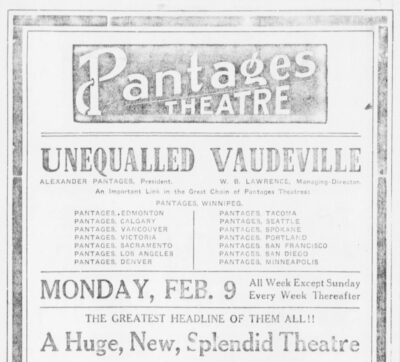
Ad for the Pantages Theatre in 1914. Source: Winnipeg Tribune, Jan 24, 1914, p. 16
The Pantages has witnessed more than a century of entertainment and creativity. Its story represents the evolution of the city’s performing arts scene and its community, from vaudeville and jazz concerts to ballet, comedy, theatre, and dance.
Today, with renewed support and a vision for the future, the Pantages Playhouse Theatre stands ready to begin its next act.
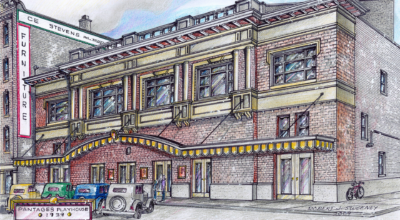
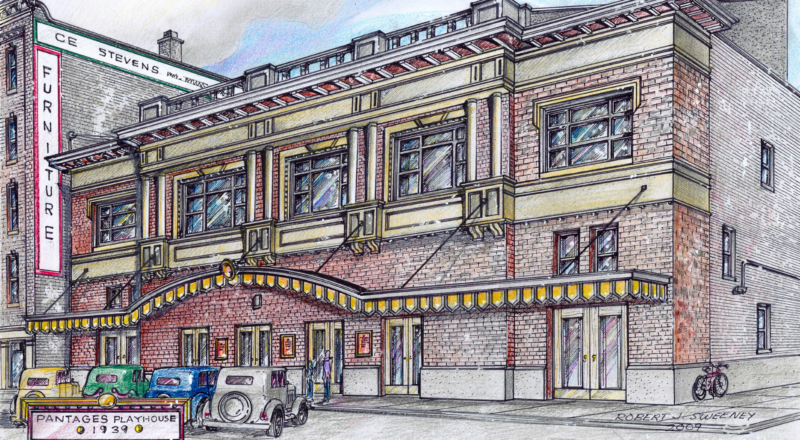
Featured Image: The Pantages Playhouse in 1939. Artwork by Robert Sweeney.
To read more about the history of the Pantages Theatre, check out our other blog on the iconic building.
THANK YOU TO THE SPONSOR OF THIS BLOG POST:

Written by Heritage Winnipeg.
SOURCES:
"Province chips in $15M to bring Pantages Playhouse back to life." Winnipeg Free Press, May 5, 2026.
"Pantages Theatre." Winnipeg Architecture Foundation.
Cassidy, Christian. "A History of Pantages Playhouse Theatre." West End Dumplings, June 2014.
"Pantages Playhouse Theatre to Rise Again." Winnipeg Free Press, June 3, 2026.
City of Winnipeg. 180 Market Avenue: Heritage Report. September 30, 1980.
Parks Canada. "Pantages Playhouse Theatre National Historic Site of Canada."
"Pantages Playhouse Theatre." Canadian Register of Historic Places.
Manitoba Historic Resources Branch. "Pantages Playhouse Theatre." Government of Manitoba.
"Winnipeg Pantages Theatre." DiscoverIT.
PastForward Winnipeg Archives (ID 11431)