



/ Blog

November 4, 2026
Brookside Cemetery: A Place of Remembrance
Beyond the traffic of the busy street, Brookside Cemetery sits at 3001 Notre Dame Avenue, designated a National Historic Site in November 2023. It offers a quieter way to encounter Winnipeg’s past. Headstone inscriptions mark lives that helped shape the city, while winding roads and mature trees invite visitors to slow down. Within these grounds, the Field of Honour holds a particular significance. Here, military history becomes personal: thousands of individual lives, remembered together.
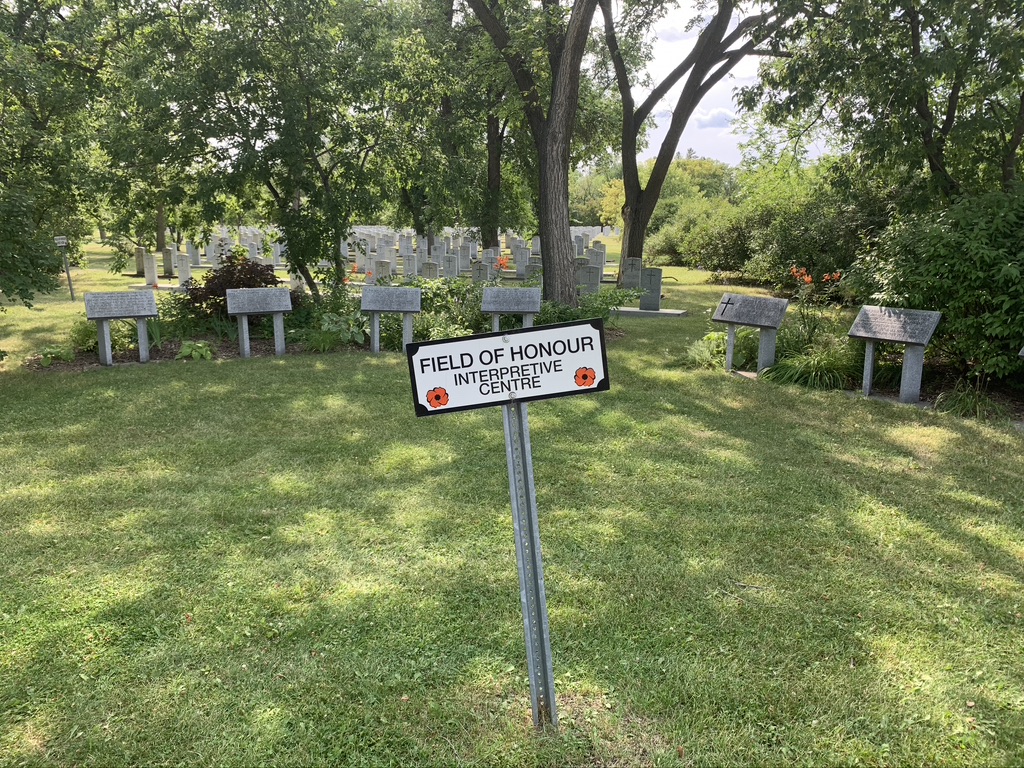
A section of the Field of Honour, August 9, 2026. Source: Heritage Winnipeg
Established in 1878, Brookside is one of Winnipeg’s oldest municipal cemeteries and one of the largest in Western Canada. Its history reaches across generations, connecting the development of the city with the experiences of those who lived, served and died here.
Brookside developed within the garden cemetery tradition, which brought landscaped grounds and places for reflection into cemetery design. Surveyor and architect Thomas H. Parr laid out its early plan between 1877 and 1883. After responsibility passed to Winnipeg’s Public Parks Board in 1896, further planting and improvements helped transform the prairie site into a carefully cultivated landscape.
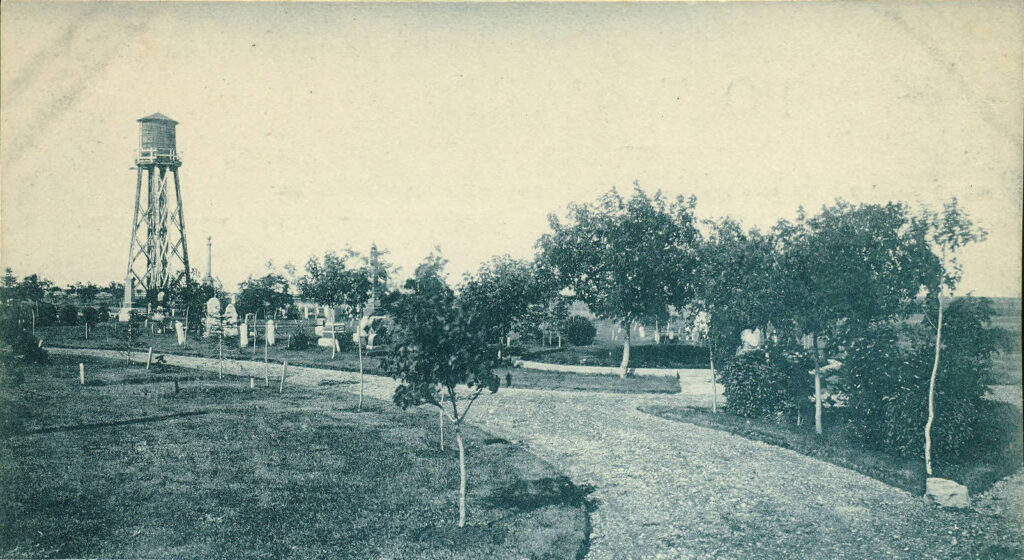
An undated postcard of Brookside Cemetery, showing grave monuments with a water tower in the background. Source: Winnipeg Public Library, Rob McInnes Postcard Collection, WP1025, PastForward (cropped, public domain).
At Brookside, this relationship between landscape and memory would take on an additional purpose during the First World War.
In 1915, the Daughters of the Empire asked the City of Winnipeg to reserve part of Brookside for the burial of returning First World War veterans. The Imperial Order Daughters of the Empire (IODE), a Canadian women’s volunteer organization founded in 1900, supported charitable work and military remembrance. The IODE were among the first to advocate establishing the Field of Honour.
The Field of Honour opened that year, establishing a lasting place for military remembrance within the municipal cemetery. Its beginnings reflected the war’s growing presence at home. Winnipeg was the headquarters of Military District No. 10 and had six military hospitals during the First World War. The city was a place where service members received treatment, bringing the consequences of overseas fighting into local wards and communities. Returning home did not necessarily mean recovery. The history of wartime service also belongs to hospitals, convalescence and the families who waited for news. Brookside provides a setting in which to explore those experiences alongside the campaigns more commonly associated with military history.
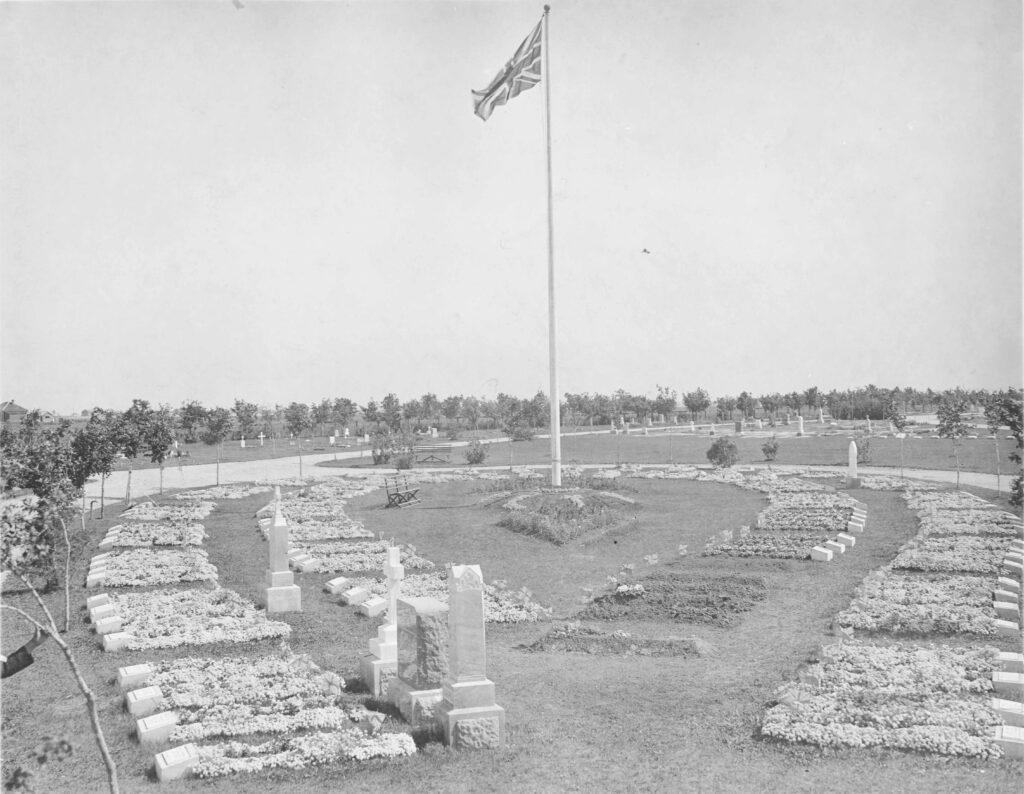
Brookside Cemetery’s military burial grounds, 1918, showing curved rows of graves surrounding a central flagpole in the area known as the “Tear Drop.” The Cross of Sacrifice was installed here in 1922. Source: City of Winnipeg Archives, Winnipeg in Focus, i03129 (cropped, public domain).
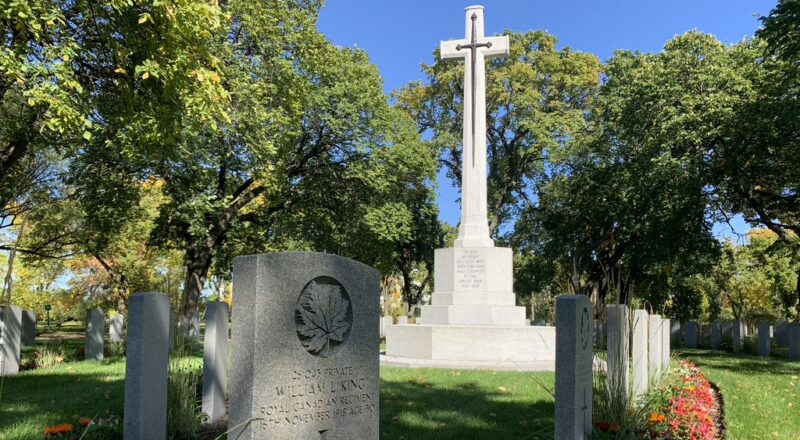
The Field of Honour’s early design is especially distinctive. Its First World War section predates the standardized cemetery arrangements associated with the Commonwealth War Graves Commission. At its centre is the “Tear Drop,” an islet with graves arranged in a teardrop shape. A Cross of Sacrifice was installed there in 1922. Later sections adopted a more formal arrangement along straight axes.
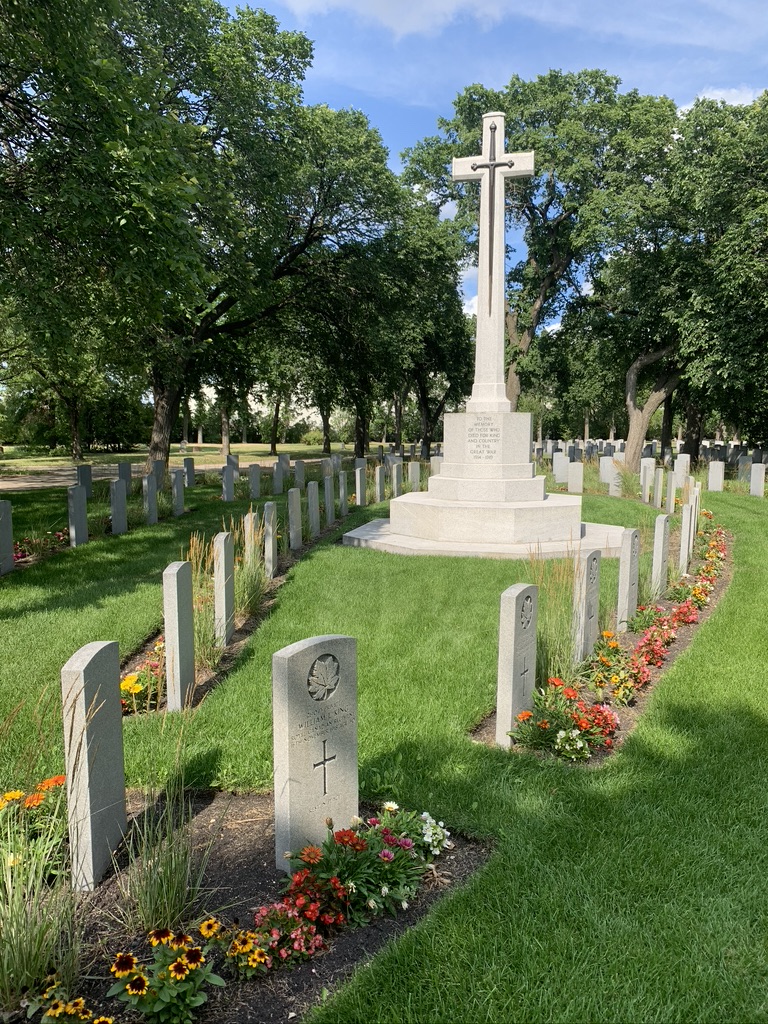
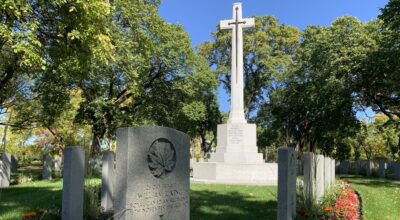
The “Tear Drop” section of the Field of Honour with the Cross of Sacrifice, honouring veterans of the First World War, September 27, 2026. Source: Heritage Winnipeg
These differences make the cemetery itself a historical source. Its layout reveals how local efforts to commemorate the deceased developed alongside military burial traditions.
Today, more than 10,000 veterans and service members rest in Brookside’s Field of Honour. The scale can be difficult to comprehend. Pausing at a single headstone offers another way to understand it: one name, one service history and one family’s loss at a time.
Among Brookside’s most significant monuments is the Great Stone of Remembrance, unveiled on October 2, 1960, by Manitoba Premier Duff Roblin. Designed by British Architect Sir Edwin Lutyens, it was provided through cooperation between the Commonwealth War Graves Commission and Winnipeg’s Board of Parks and Recreation.
The monument honours Commonwealth sailors, soldiers and airmen of the two world wars who lie buried in Canada. It is the only Commonwealth War Graves Commission Stone of Remembrance in the country. Its inscription includes the words, “Their name liveth for evermore.”
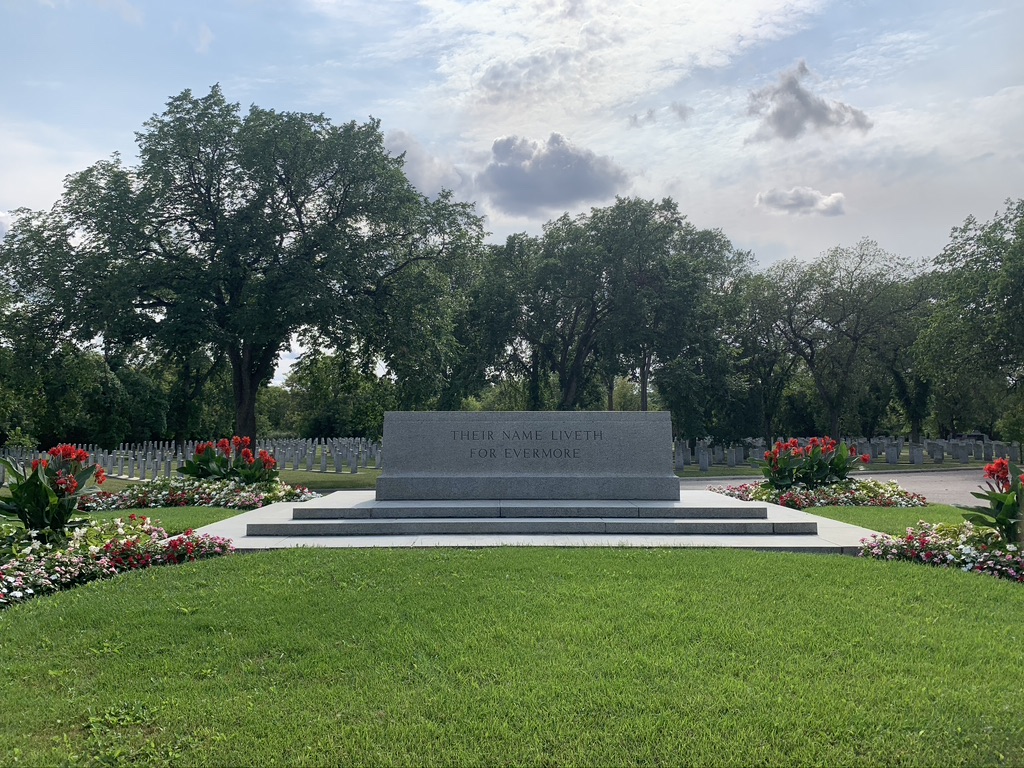
The Great Stone of Remembrance, August 9, 2026. Source: Heritage Winnipeg
That promise gives remembrance a continuing responsibility. Names remain legible because people maintain the headstones, preserve the records and take time to read them. A memorial’s meaning depends partly on what later generations choose to learn.
Among those buried in Brookside’s Field of Honour is Joseph Benjamin “Joe” Keeper (1886–1971), whose life connects athletic achievement with First World War service. A long-distance runner from Norway House, Keeper represented Canada at the 1912 Olympics before joining the army in 1916. During the war, Keeper received the Military Medal for bravery for his actions at Cambrai, France, in 1917.
Keeper died on September 29, 1971, and was buried at Brookside on October 2. The City of Winnipeg’s burial records identify his resting place as Field of Honour. His headstone provides a place to remember a life whose achievements reached far beyond the cemetery grounds.
Learning about people such as Keeper gives depth to a walk through the Field of Honour. Each grave marks a person with a life before military service, experiences during it, and a story that deserves to be remembered.
Brookside’s Korean Veterans Cairn and Hong Kong Veterans Cairn provide further places to explore the different conflicts and experiences represented within its grounds.
Remembrance at Brookside continues through community participation. Its annual Candlelight Service of Remembrance began in 2012. Volunteers, youth organizations, cemetery staff and community members help place flameless lights at the more than 10,000 graves in the Field of Honour.
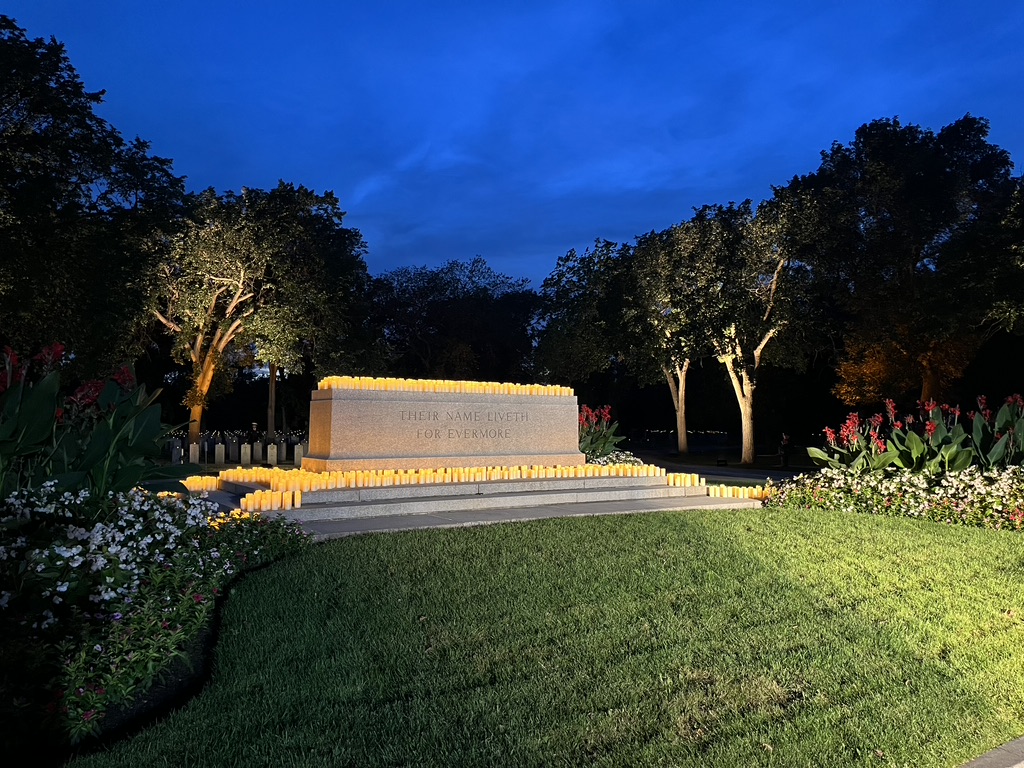
The Great Stone of Remembrance lit with candles for the annual Candlelight Service of Remembrance, September 10, 2026. Source: Heritage Winnipeg
Each light draws attention to an individual resting place. Together, they reveal the scale of the community’s responsibility to remember.
Brookside was designated a National Historic Site, recognizing the importance of its landscape and military burial traditions. Preserving that heritage requires care for the grounds, monuments and records, as well as opportunities for people to understand them.
A visit need not wait for November 11. Walking through the Field of Honour, reading a name or researching a life can become an act of remembrance. Brookside brings the history of war close to home, asking us to consider the people who served, the losses their communities carried and the value of the peace we inherit.
Visit our digital First World War Memorial on our website to learn more about those who served and sacrificed for our country. https://thegreatwar.heritagewinnipeg.com/memorial/#/app/info
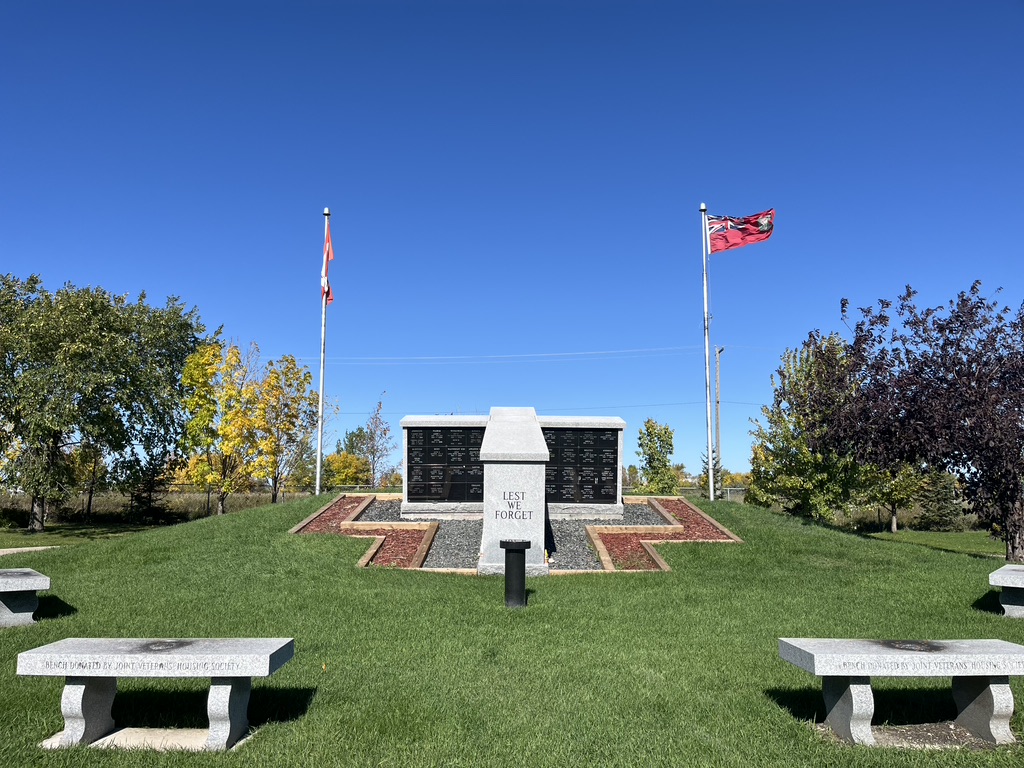
The Last Post Fund / Veterans’ Columbarium, September 27, 2026. Source: Heritage Winnipeg
THANK YOU TO THE SPONSOR OF THIS BLOG POST:

SOURCES:
City of Winnipeg. Brookside Cemetery.
Parks Canada. Brookside Cemetery National Historic Site.
City of Winnipeg. Field of Honour.
Commonwealth War Graves Commission. Winnipeg (Brookside) Cemetery.
Veterans Affairs Canada. Great Stone of Remembrance.
Manitoba Historical Society. Joseph Benjamin “Joe” Keeper (1886–1971).
Parks Canada. Government of Canada designates Brookside Cemetery as a National Historic Site.