










/ News

June 17, 2026
A Living Memory: New Progress on Carnegie Library Restoration
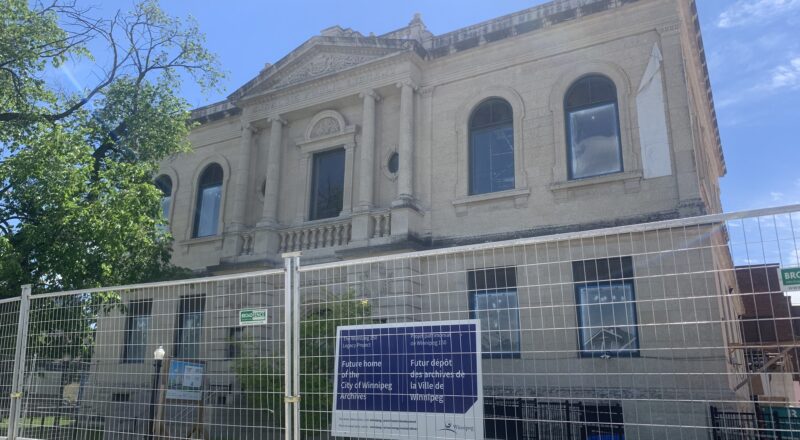
The former Carnegie Library at 380 William Avenue is entering a new phase in its long and evolving history. Once Winnipeg’s first purpose-built public library, the building is now being transformed into the permanent home of the City of Winnipeg Archives, bringing the city’s historical records back to where many of them were first housed.
The Carnegie Library was founded in 1901 with a $75,000 grant from philanthropist Andrew Carnegie, who funded more than 2,500 libraries worldwide. Designed by architect Samuel Hooper in the Classical Revival style, the cornerstone was laid in 1903, with the building officially opening in 1905.
When the building first opened, Winnipeg was growing rapidly. The demand for books and public learning spaces was high. The library quickly became one of the most heavily used in Canada, recording hundreds of thousands of annual loans. Its popularity led to an expansion in 1908, only three years after opening. Above its entrance, the words “Free to All” were carved into Tyndall stone, a symbol of its lasting duty to public knowledge.
The building served as Winnipeg’s main library until 1977, when the Millennium Library (then Centennial Library) opened downtown. It then transitioned into a shared space that housed both a branch library and archives.
By 1994–1995, the building’s role shifted fully to archival storage, growing a large collection of municipal records documenting Winnipeg’s development, including materials dating back to the 1870s and records from former municipalities merged under unicity in 1972. Other records include plans, maps, photographs, and artifacts from the community. For nearly two decades, the Carnegie Library functioned as the City of Winnipeg Archives.
In 2013, a severe rainstorm flooded the building during renovation work. Parts of the structure were damaged, forcing the relocation of the archival collection. The archives were transferred to a warehouse at 50 Myrtle Avenue. Archivists and historians using the new location have said that it is not sufficient for long-term preservation with restricted environmental controls, limited space, and reduced public access creating obstacles for both conservation and research. Reports after the relocation mention a decline in visitor numbers and the growing concern about the preservation of fragile, irreplaceable materials. Heritage Winnipeg advocated for consecutive years to see the building restored and the archives returned. After extensive debate and planning, the City of Winnipeg approved funding in 2023 for the building’s restoration as a new archival centre, initially estimated at approximately $12.6 million.
The rising of construction costs, cleanup of hazardous materials, and updated design requirements would stall the restoration. By 2025, a revised budget of approximately $22 million was approved, and the redevelopment contract was awarded to Bockstael Construction. The project also forms part of the Winnipeg 150 Legacy initiative.
Construction resumed in late 2025, the first major work on the building in more than a decade. The project involves heritage restoration alongside structural upgrades. The upgrades include 60,000 kilograms of steel shelving being installed, flood-resistance improvements, new structural steel reinforcement, a fire suppression system, climate-controlled archival storage and spaces for research and public programming. New areas will also host reconciliation initiatives, including displays of Indigenous culture and smudging ceremonies.
In June 2026, the project was reported by the City of Winnipeg to be one-third complete. Historic architecture, mouldings, woodwork, masonry, including original windows, columns and the terrazzo staircase, was carefully preserved or replicated. Original bricks were also salvaged and reused to preserve the integrity of the building’s past. The reconstruction is expected to be complete in 2027.
During the reconstruction, workers began uncovering historical artifacts hidden in the walls and the building’s basement. A newspaper from December 30, 1912 in part of the wall covering, City Council highlights, hockey news about Albert Kerr, an advertisement for $1.55 men’s coats, an ether dispenser from 1913, a Bristol Company milli-voltmeter in a wooden box from the early 1900s, and a Bernie Wolfe election campaign poster. The items found were reported to be given to the Archives staff for preservation. These artifacts are a reminder that the building itself is an artifact of Winnipeg’s history.
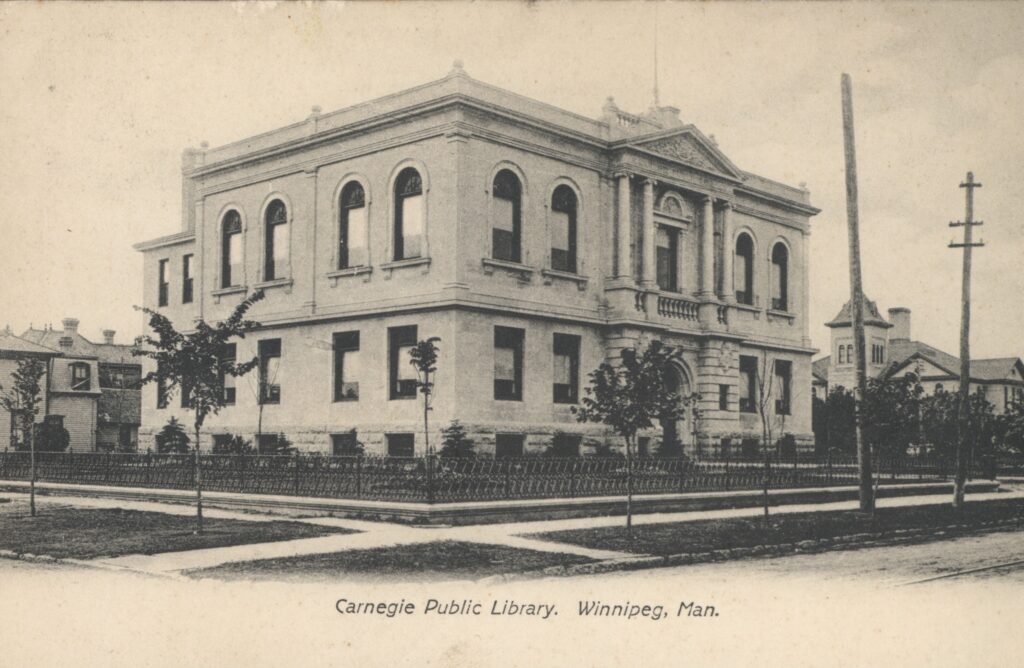
The Carnegie Library in 1905. Source: City of Winnipeg Archives Photograph collection (public domain).
The renewed Carnegie Library will serve as a modern, purpose-built facility for the City of Winnipeg Archives. For the first time in its history, the archives will have a climate-controlled vault designed specifically for long-term preservation. City archivist Konrad Krahn states that, “This is the first time we’ll be able to actually protect our treasured records…for future generations to come.” (“Safeguarding Winnipeg’s History,” Winnipeg Free Press, June 15, 2026, https://www.winnipegfreepress.com/local/2026/06/15/safeguarding-winnipegs-history.)
The renewal is also meant to increase public engagement with Winnipeg’s historical records with improved access and programming. Konrad Krahn adds that the redevelopment is a reconnection, “We always think of archives not just as preserving the past, but as essential civic infrastructure” (Ibid), returning the archives to a building that has long represented Winnipeg’s civic identity and access to knowledge.
Across more than a century, the Carnegie Library has repeatedly adapted to meet Winnipeg’s changing needs. The building’s carved inscription, “Free to All,” remains central to its ideals. Carnegie Library is once again being reshaped for public use, and it is important to remember that it is not just a repository of books, but is a living memory of Winnipeg itself.