









/ News

July 14, 2025
Another Smiling Face
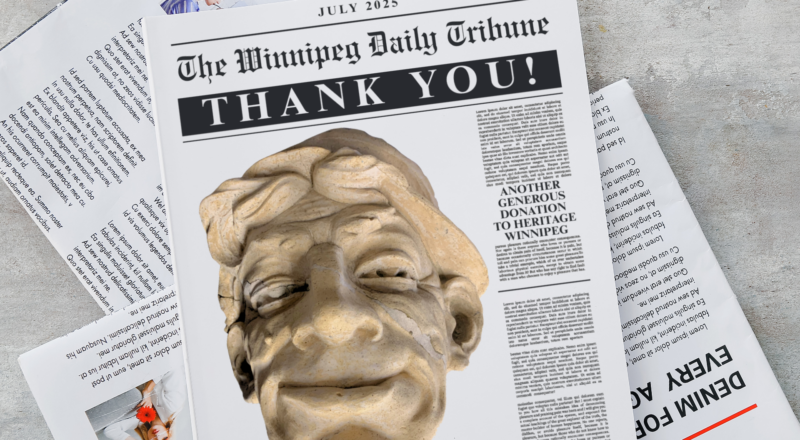
Heritage Winnipeg would like to thank Robert Baxter for his generous donation of a Tribune Building shard. This shard, salvaged from the facade of the 1914 structure at 257 Smith Street in 1969, is the second of 14 terracotta heads from the Tribune Building to find a home in our office. We hope the two fellows had a happy reunion after spending 56 years apart and we are delighted to be graced with their company!
The shards are part of Heritage Winnipeg’s growing collection of memorabilia from the Winnipeg Tribune, an iconic newspaper in the city published from 1890 until 1980. Caring for these artifacts ensures the history of the newspaper lives on, filling in voids left behind when the presses abruptly stopped and the building later demolished.
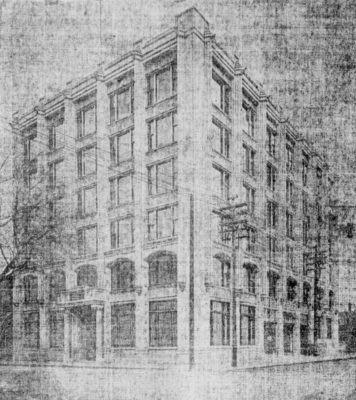
The Tribune Building at 257 Smith Street shortly after opening in 1914.
Source: The Winnipeg Tribune – March 7, 1914, page 32
A shard is created when something brittle breaks into fragments, often with sharp edges. In the case of architecture, shards are the fragments of a building, usually the result of the building being demolished. While the Tribune Building was demolished in 1983, these shards were broken off the facade 14 years prior, either as an update to the design or because they were at risk of falling off.
Gifted or sold by the newspaper, the Tribune Building shards ventured far from home, changing hands over time. Baxter’s shard was first owned by Aubrey Halter, a Winnipeg real estate developer and entrepreneur. After Halter passed away in 2008, his family passed the shard on to Peter Roy, who in turn gave it to David Perrett, a a Hamilton based sculptor who grew up in Winnipeg. It then came into the care of Baxter, who donated the shard to Heritage Winnipeg.
Two types of shards were removed from the Tribune Building in 1969, 14 small human characters from the roofline and 14 large human heads from the columns between the first and second floors. While both are colloquially referred to as gargoyles, both are actually grotesques.
Grotesques are decorative figures in architecture; sometimes mythical, sometimes whimsical and often distorted looking. Some of the earliest examples date back to ancient cultures. Later grotesques became popular during the European Middle Ages, when designs became larger, more elaborate and imaginative. The fanciful creatures were symbolic as well as decorative. They could scare away evil spirits, or be a scary reminder of hell – the meaning was dependent on the context.
Gargoyles are a specific type of grotesque. They were decorative creatures that function as water spouts to direct rainwater off a building and away from the foundation. While water generally spouted out of the mouth of a gargoyles, some were rather cheeky, with the water spouting out of their back end instead!
All the characters from the Tribune Building are grotesques, as none of them functioned as water spouts. Although they were made in the 20th century by the American Terra Cotta and Ceramic Company in Illinois, they are a nod to the the Gothic period when such decoration was popular. The clothing of the characters along the roof was medieval in fashion, and they held traditional tools from the newspaper trade, like scissors and an old fashioned screw printing press. At about two feet tall, their twisted terra cotta bodies peered down at the oblivious pedestrians below.
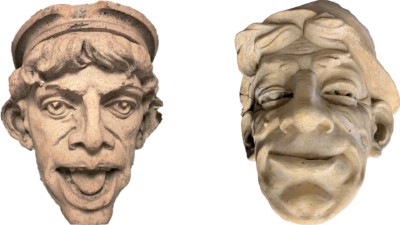
The two Tribune Building shards donated to Heritage Winnipeg.
Source: Heritage Winnipeg
The heads of the Tribune Building were styled similarly to the character found above them, only on a larger scale. At about 20 inches tall, their expressive features were more exaggerated and would have been quite noticeable to Winnipeggers walking by. Without the rest of their bodies or tools in hand, it is harder to determine what the heads were meant to represent, although it is thought they are also newspaper related. Following this line of thinking, the latest head donated to Heritage Winnipeg (shown above on the right) potentially represents a paperboy. What could the first head donated (shown above on the left) possibly represent with its wide mouth open? It is rumored that the heads represent the four corners of journalism: the reporter, the editor, the paperboy and the customer.